The Research This Is Actually Built On
Every substantive claim we make elsewhere on this site links back to something here. Where the evidence is solid, we say so. Where it's contested, unreplicated, or just plain folklore, we say that too — including about research we reference favorably.
1. What the Emolio Scanner Actually Runs: a Hardware TRNG
The scanner is built around a true random number generator (TRNG) — a hardware entropy source, not a software pseudo-random algorithm. This is well-documented, unremarkable engineering: our TRNG draws entropy the same way ESP32-class microcontrollers commonly do, from RF/radio noise.
The genuinely open question isn't whether the TRNG produces true randomness — it does. It's whether a trained operator's state, intention, or timing can correlate with that randomness in a way that carries useful information. That's a real, decades-old research question, not something we invented, and it remains unresolved.
2. PEAR — Princeton Engineering Anomalies Research (1979–2007)
Status: real effect claimed, tiny, disputed on methodology
A Princeton University lab run by aerospace engineer Robert Jahn ran tens of millions of trials from 1979 to 2007, testing whether focused human intention could shift the statistical output of random event generators. They reported a real, statistically significant effect — but a tiny one, under 1% deviation from pure chance.
Independent statisticians and the wider scientific community still dispute this on methodology and interpretation — effect sizes this small are exactly where selective reporting, optional stopping, and multiple-comparisons problems tend to produce false positives, and PEAR closed in 2007 without the effect being broadly accepted. We cite this as the origin of the research question, not as proof of anything.
3. Stanford Research Institute (1970s–early 1990s)
Status: contested, partly classified, never independently confirmed
A separate program at SRI International (an independent research institute, no longer affiliated with Stanford University despite the name) studied related anomalous-cognition claims from the 1970s into the early 1990s, partly funded by the CIA as part of a broader Cold War-era research effort. Results were similarly contested, and much of the funding and framing was military/intelligence-driven rather than purely scientific — worth knowing when weighing how much to trust the source.
4. Presentiment Research — Radin, Bierman, Jolij
Status: not replicated by independent/skeptical labs
This is the closest research analogue to what a scanner operator would need to be doing: physiological presentiment, the idea that the body reacts, in a small statistical way, to a random future stimulus before it happens. Dean Radin first ran this paradigm in 1997; Dick Bierman (University of Amsterdam, later Groningen) reran it with fMRI; Jacob Jolij (University of Groningen) later ran EEG versions reporting prediction accuracy around 53–55% against a 50% chance baseline.
What Science Says
We are not going to soften this: independent replication attempts by skeptical researchers (Ritchie, Wiseman & French, 2012) found no significant effect, and a detailed 2014 critique ("We should have seen this coming") flagged that several supportive studies, including Bierman's own fMRI work, were never published in peer-reviewed journals — only conference proceedings. A related and more famous case, Daryl Bem's 2011 "Feeling the Future" paper, triggered failed replications across psychology and is now widely cited as a catalyst for the field's replication crisis.
What Practice Says
Experienced practitioners across many fields — not just bioresonance — describe trusting a trained "gut sense" that turns out right more often than they'd expect from guessing. That reported experience is exactly what presentiment research set out to test formally. Reported confidence isn't the same as a demonstrated effect, which is exactly why it needed testing in the first place.
What Tradition Says
Premonitions, omens, and dreams that seem to foretell events appear independently across nearly every culture's folklore, going back millennia. That near-universality doesn't make any single premonition real, but it does mean the underlying human experience presentiment research tried to test is old and widely reported, not a modern invention.
Try It Yourself
Before a genuinely random event you'll learn the outcome of soon — a shuffled card, a coin app, a lottery-style draw — write down your gut guess first, sealed or timestamped so you can't edit it after. Log every attempt, not just the hits, for at least 30 tries. Chance alone gets you roughly half right; anything meaningfully above that, honestly logged over enough tries, is worth telling us about.
We cite this area because it's the honest, real research this general idea sits next to — not because it's settled. It isn't. Treat any bioresonance company that tells you this is proven as telling you something false.
5. René Peoc'h — Biological Intention and a Random-Number-Generator Robot
Status: fringe journals only, unreplicated, not accepted by mainstream science
Closer to what our own device actually does: parapsychologist René Peoc'h ran a series of experiments between 1986 and 1995 in which newborn chicks were imprinted on a small robot that moved in a pattern steered by a hardware random number generator. Peoc'h reported that the imprinted chicks' presence appeared to bias the robot's random path toward them, and in one later variant, the RNG hardware itself was situated 23 kilometers from the robot.
These results were published only in fringe parapsychology journals, not mainstream peer-reviewed science, and have not been independently replicated since. We mention it because it's a genuine historical precedent for "biological state influencing a hardware RNG" — the same structural claim our own research rests on — not because it settles anything. It's exactly the kind of experiment we'd want to see redone properly, with modern equipment and independent oversight.
6. Voll, Radionics, and Why This Category Has a Trust Problem
Reinhold Voll, a German physician, developed Electroacupuncture According to Voll (EAV) in 1958, measuring skin resistance at acupuncture points on a galvanometer and claiming the readings indicated organ inflammation or degeneration. No EAV or "electrodermal screening" device has ever received full U.S. FDA approval for diagnosing disease; some have only been cleared as simple biofeedback meters, and regulators have repeatedly acted against manufacturers who oversold the diagnostic claims.
What Science Says
No validated physiological mechanism, no full regulatory approval for diagnosis, and no controlled trial showing EAV outperforms chance. That's a real, verifiable gap — not the last word on whether it helps anyone.
What Practice Says
Plenty of working practitioners report real clinical value from EAV in their own sessions. We're not dismissing that — but practitioner-reported results are exactly the kind of evidence that's hardest to separate from placebo, regression to the mean, and wanting to see a result, which is precisely why regulators ask for controlled trials in the first place.
What Tradition Says
EAV grafted a Western electrical measurement onto acupuncture-point theory, itself thousands of years old in East Asian medicine. The acupuncture-point map predates and doesn't depend on Voll's specific machine or claims.
Try It Yourself
You don't need to own an EAV device to test this honestly. Before your next visit to any practitioner who uses one, write down your symptoms and how you'd rate them, sealed and undisclosed. Compare your own note to what the reading says afterward — that's a small, real check on whether the reading is telling you something you didn't already know.
EAV itself descends from radionics, pioneered by Albert Abrams in the early 1900s, whose devices claimed to diagnose and cure disease from a blood sample via "electronic oscillations." A blind test arranged by the AMA — testing blood from a healthy person, a dead man, and a rooster — publicly discredited him; he is now the textbook historical example of medical-device quackery. Ruth Drown, influenced by Abrams, built similar devices in the 1940s–50s and was indicted for grand theft in 1963 for treating patients for diseases they didn't have; she died before trial.
More recently, the EPFX — also sold as the QXCI, "Quantum Xrroid" — was marketed in the 1990s as if it definitively read the body's energy. Regulators and, eventually, a criminal fraud case found its actual "reading" mechanism was a random number generator, with none of the diagnostic certainty claimed for it.
We put this history on our own site deliberately. The difference between a device like ours and the EPFX case was never the presence of randomness — plenty of legitimate hardware uses randomness. It's whether the company tells you the truth about what the device is actually doing. That's the bar we're holding ourselves to.
7. Different Mechanisms Entirely: Frequency and Light Effects on Cells
Status: preliminary preclinical research, not yet replicated independently
Separate from anything above, there is real preliminary research on whether specific oscillation frequencies can affect living cells directly — a genuinely different mechanism than a TRNG-driven scan, and worth naming honestly rather than lumping in. Anthony Holland, a professor at Skidmore College (not a physician or oncologist by training) who runs the small nonprofit lab Novobiotronics, has published early in-vitro results applying frequency-specific pulsed electric fields to cultured cancer cell lines via a plasma-antenna device, reporting growth inhibition in some cell lines at certain frequencies.
This work has appeared as conference posters, a preprint, and self-published lab reports — not in peer-reviewed oncology journals, and with no human clinical trial data yet. It's early-stage, unreplicated by independent labs, and petri-dish results are a long way from a working therapy.
We are deliberately not repeating a popular version of this story that links it to funding-suppression conspiracy narratives or to Raymond Rife's 1930s "Rife machine" claims. We looked for a documented, verifiable version of that story and couldn't find one — what exists is Holland's own framing in talks and crowdfunding appeals, and sympathetic blog posts, not documented suppression. The real story is simpler and less dramatic: an under-resourced academic lab doing legitimate but very early research.
Biophotons — Real Physics, an Unproven Leap to "the Aura"
Status: real, mainstream phenomenon; its popular "aura" interpretation is not
Biophysicist Fritz-Albert Popp helped establish that living cells emit ultra-weak photons ("biophotons") tied to normal metabolic activity — this part is real, still-researched, peer-reviewed physics, measured with photomultiplier equipment far more sensitive than the human eye.
What is not established is the popular claim that this is "the scientific basis for the aura." No mainstream source makes that connection — biophoton emission is thousands of times too faint to be seen by eye, and nothing about it resembles the visually-perceived colored field that "aura" usually describes. We're naming the real phenomenon and cutting the invented bridge to the popular one.
8. Why We Want to Research This With You
Here's a personal one, and we want to be exact about what it is and isn't. Emolio's founder had a Helicobacter pylori infection that, going by symptoms, cleared up during a period of magnet-based frequency work. There was no lab test before and after to confirm it — no breath test, no stool antigen test, nothing that would let us say the infection was actually eliminated rather than having resolved on its own, or that the timing was anything but coincidence.
We are not presenting that as evidence. A single, unconfirmed, self-reported case is worth exactly what it sounds like: a reason to go look, not a result. What we want instead is to actually go look — properly, with real before-and-after lab testing, alongside practitioners and patients willing to document real cases as they happen, good or bad outcomes both published.
If you have a case like this, or you're a practitioner willing to run one with real lab confirmation, we want to hear from you: info@emolio.nl
On the Egely Wheel: What We Saw, and What the Mainstream Explanation Is
What Science Says
Hungarian physicist György Egely ran an earlier, more elaborate version of this at the Hungarian Academy of Sciences' Central Research Institute for Physics: hundreds of high-school students across three schools tried to rotate water in a Petri dish with their hands, filmed and measured with floating markers (KFKI-1986-94/K, a real institutional preprint -- read it yourself). It's more rigorous than we first gave it credit for -- but Egely's own paper admits the database "is not wide enough" for real statistics, that success correlated heavily with weather, group excitement, and belief in the task, and, tellingly, that skeptical colleagues who succeeded were "not on record." The later commercial "Egely Wheel" is a simplified descendant of this work, and the mainstream physical explanation for a wheel turning near a hand is still thermal convection -- body heat creating a small, real air current.
What Practice Says
Practitioners who use wheels, pendulums, and similar low-friction tools report consistent hand- and intention-dependent movement in their own sessions. Same caveat as everywhere else on this page: reported clinical or personal experience isn't controlled evidence, however consistent it feels to the person holding it.
What Tradition Says
"Life energy" under many names — chi, qi, prana — is one of the oldest and most cross-cultural concepts in human history, independently arrived at across East Asian, South Asian, and other traditions. That doesn't make it physically real, but it's a real, ancient, widely-shared human observation worth taking seriously as a question, not dismissing as invented.
Try It Yourself
Here's our own first-hand account, offered as exactly that — an account, not evidence. Emolio's founder has tried this personally and had others try it too: the wheel turning one direction with one hand and the opposite with the other, and on at least one occasion, appearing to respond from about 3 meters away with focused attention alone, no hand involved. Convection doesn't obviously explain a distance effect or a hand-dependent direction change, which is exactly what makes it worth testing properly — blinded, distance-controlled, airflow ruled out. Build or buy a low-friction wheel, log what you see, and come share it with us.
Want to replicate the original 1986 version instead? Here is the exact setup from the paper, down to the measurements:
- Dish: a glass Petri dish (or similar shallow glass bowl) 14 cm across, filled with plain water to within 1-2 mm of the rim.
- Marker: a small floating marker on the water — the original used a thin triangle of aluminium foil about 1.2 cm across; a small twig or folded paper triangle works too.
- Hand height: generally 1-5 cm above the water surface, never touching the water, the dish, or each other. (One outlier subject worked from 15 cm up and still got a clear 360°/minute rotation, but 1-5 cm is the norm.)
- Hand position: rest your forearms on a support at dish-rim height so your hands stay still — steadiness mattered more than the students expected. Use either the "L" position (one hand flat and horizontal, reaching in over the dish; the other hand vertical, edge-on, on the opposite side) or the "T" position (both hands flat and horizontal, reaching toward each other from opposite sides) — see the figure below.
- Draft control: shield the dish from moving air (a box or enclosure around it) — airflow is the number one false positive.
- What counts as a result: in the paper, a trial only counted as "successful" if the marker visibly rotated at least 30°. It usually took 2-3 minutes of steady concentration before anything moved, often starting with a brief flicker counter-clockwise before settling into a steady clockwise drift. About two-thirds of student attempts showed no movement at all — this is normal, not a sign you are doing it wrong.
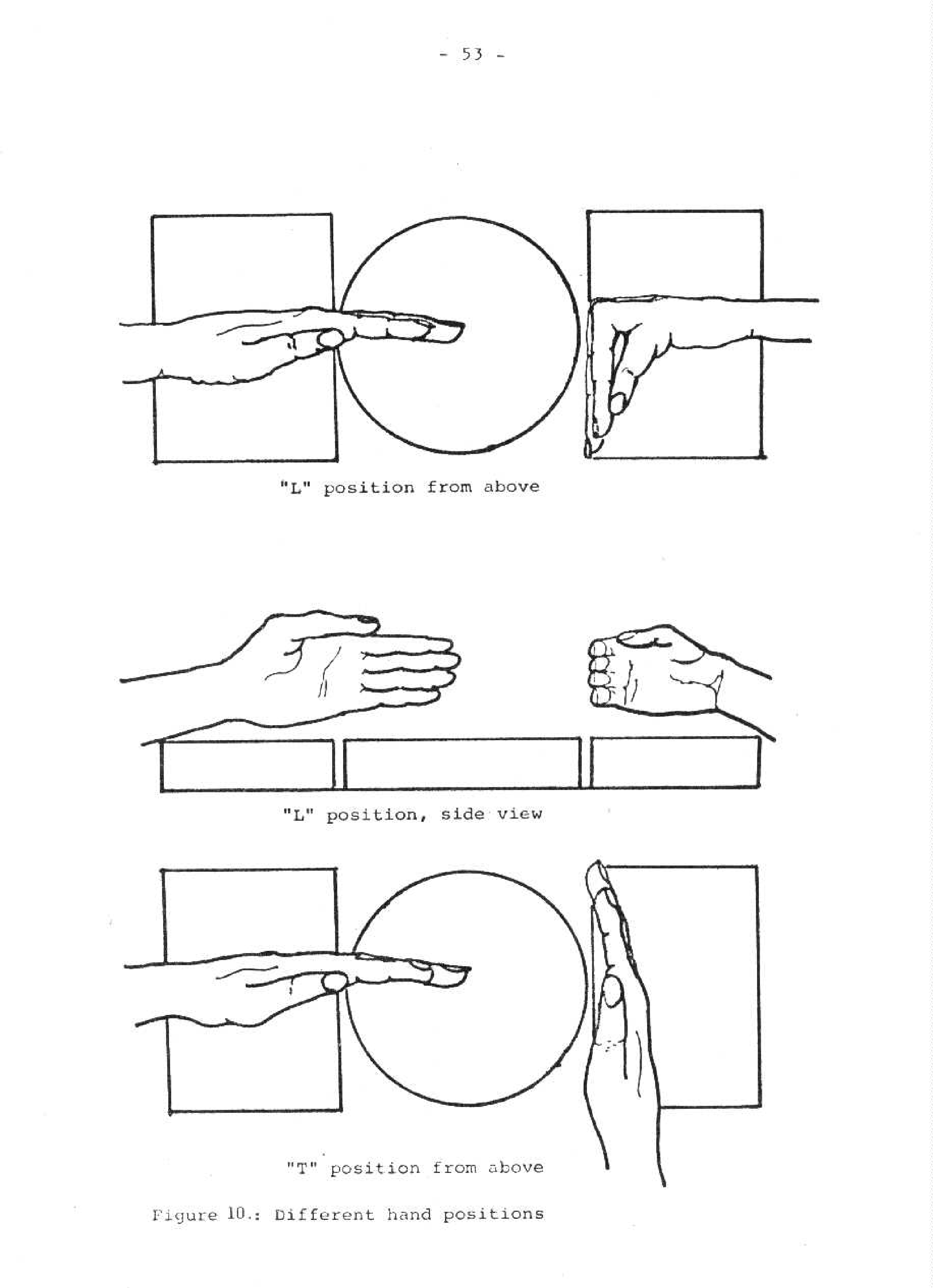
Figure 10 from the original paper: the "L" and "T" hand positions, one hand flat and horizontal, the other rotated toward the dish from the opposite side — neither touching the dish, water, or enclosure.
Part of why this category is so thin on rigorous research is a plain economic one, not a conspiracy: a new drug molecule can be patented, which is what funds the large, expensive clinical trials that produce solid evidence. A frequency or a simple physical protocol is much harder to protect that way — specific devices and methods can still be patented, but the underlying principle usually can't be owned the way a drug can, so there's far less commercial incentive to fund the kind of trial that would settle the question either way. The clearest real-world parallel is generic drug repurposing: research consistently finds that already-off-patent drugs with plausible new uses stay chronically under-tested, not because the science looks bad, but because no company captures a return on running the trial. We think the same dynamic applies here, and it's a funding problem worth naming honestly rather than a reason to assume the effect is real.
This section will grow. We're tracking other threads worth researching properly — including older experiments pairing animal subjects with hardware random number generators — and we'll add each one here honestly, with the same rules: real sources, clear caveats, and a bias toward actually testing things over asserting them.
Full Source List
- Psi Encyclopedia — Presentiment
- Psi Encyclopedia — Dick Bierman
- Schwarzkopf (2014), "We should have seen this coming" — critique of presentiment studies
- Ritchie, Wiseman & French (2012) — failed replications of Bem's "Feeling the Future"
- Mossbridge, Tressoldi & Utts (2012) — presentiment meta-analysis (proponent view)
- Quackwatch — Electroacupuncture According to Voll (EAV)
- Science-Based Medicine — electrodermal testing devices and regulators
- Albert Abrams and the AMA blind test
- Ruth Drown — radionics, 1963 indictment
- Holland et al. — oscillating pulsed electric fields on cancer cell lines (preprint)
- Novobiotronics — lab reports
- Peoc'h — chicks' distant psychokinesis (1995, fringe journal)
- Fritz-Albert Popp — biophoton research
- Ultra-weak photon emission — brief review (PMC)
- Egely, "Experimental Investigation of Biologically Induced Energy Transport Anomalies," KFKI-1986-94/K (full preprint, hosted here)
- György Egely — background (promotional source, read critically)
Want the Full Walkthrough?
The free course covers all of this in more depth, plus how the scanner actually works.
Start the Free Course